Backflow Prevention Testing & Installation Near Me
Starting price: Call for pricing
Backflow prevention keeps your drinking water safe by stopping reversed water flow from pulling contaminants back into your supply. Plumbing Pros installs the right backflow assembly for your hazard level and keeps it in compliance with scheduled annual testing.
What backflow prevention testing and installation is
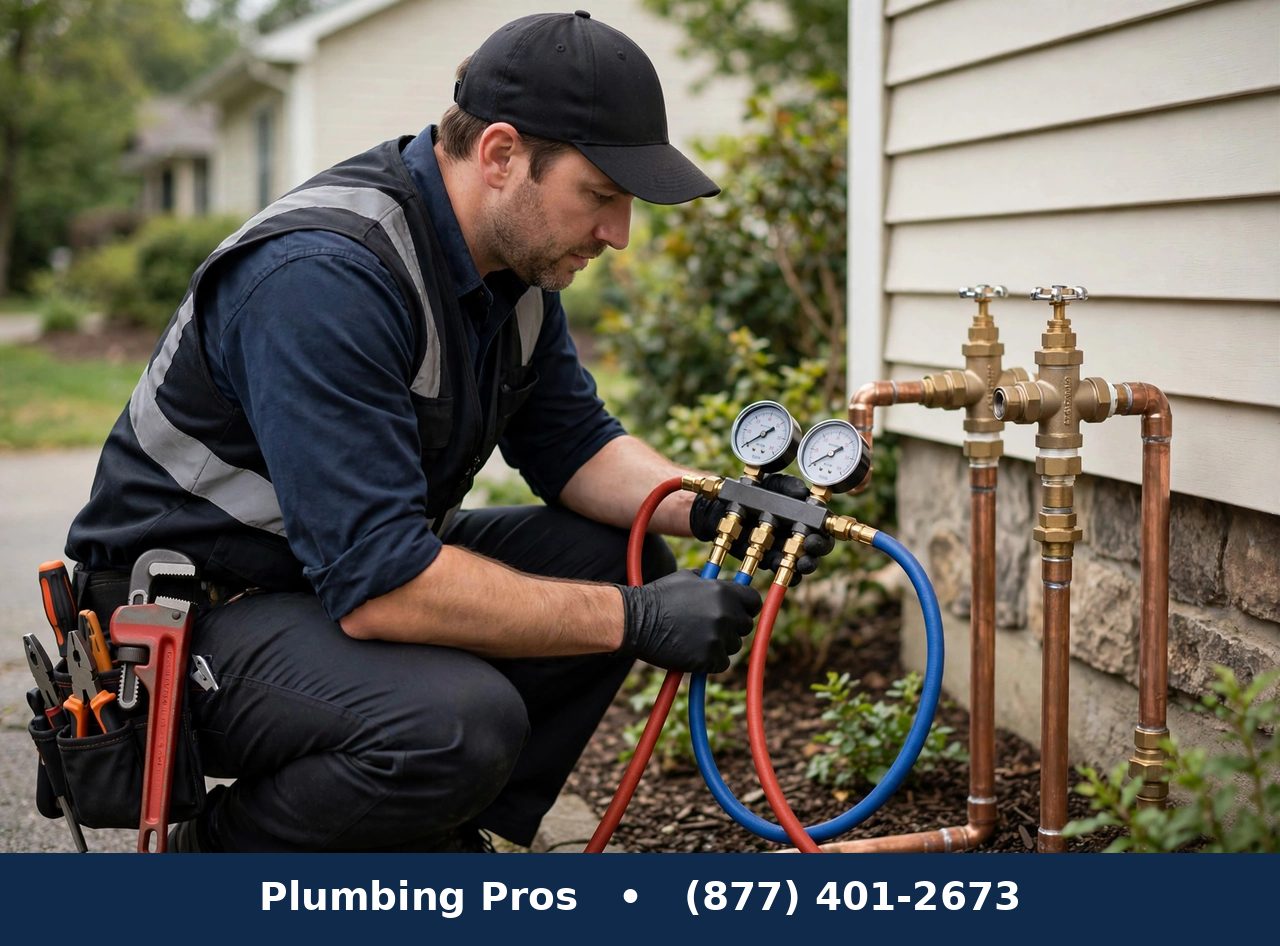
Backflow prevention testing verifies that the valve assembly guarding your drinking water still stops reverse flow. During a test, a technician briefly shuts off the water and connects calibrated gauges to the assembly's test ports to confirm each check valve and relief valve holds pressure as required. The recorded readings become your proof of compliance, filed with your water authority.
Installation is the other half of the service. Wherever a cross-connection exists — a point where potable water meets something you would never drink — an assembly is installed to block the backward flow. Common cross-connections include lawn irrigation systems, garden hoses, swimming pools, boiler feed lines, and fire sprinkler systems.
What testing and installation does not cover matters too. A backflow assembly does not filter water, soften water, or fix water pressure problems. It is a one-way gate, nothing more, and its whole job is keeping contaminated water from moving in the wrong direction.
There are two ways backflow happens. Backsiphonage occurs when supply pressure drops suddenly — a water main break, a fire hydrant opened nearby — and the vacuum pulls water backward. Backpressure happens when a boiler, pump, or elevated tank pushes harder than the supply. Both can draw fertilizer, soap, pool chemicals, or stagnant water into the drinking supply.
When you need testing or a new device
Most property owners first hear about backflow from a letter. Your water authority may require annual testing of any testable assembly on the property, and missing the deadline can bring penalties or a shutoff notice. Beyond compliance, there are practical moments when testing or installation is the right call.
- You received a notice requiring an annual backflow test or compliance report
- A new irrigation system was installed or an old one was upgraded
- You added a pool, water feature, boiler, or fire sprinkler system
- Outdoor hose bibbs have no vacuum breaker, or hoses sit submerged in buckets or pools
- A renovation or new tenant introduced process water, chemicals, or equipment tied to the supply
- Your assembly failed its last test and needs repair or replacement
- You bought a property and have no record of its backflow devices
The pattern is simple: if water leaves your plumbing and could come back changed, it needs a guard, and that guard needs regular verification.
How the process works
It starts with a call to Plumbing Pros. Describe your situation — a compliance letter, a new sprinkler system, a device that is dripping — and you will hear the next steps, including what access the tester needs and when to expect them.
For testing, the tester locates each assembly, notifies you of a brief water interruption, and shuts the upstream valves. Using calibrated differential gauges, each check valve and relief valve is tested against the required thresholds. The passing readings go on a compliance form that is sent to your water authority; a failure gets a clear explanation and repair options.
For installation, the process begins with a survey. The technician identifies each cross-connection on the property and determines the hazard level, which dictates the type of assembly required. Reduced pressure zone assemblies handle high-hazard connections like boilers and chemical feeders. Double check valve assemblies suit lower-hazard situations. Pressure vacuum breakers and atmospheric vacuum breakers are common on irrigation lines.
The assembly is then installed with the required clearances, tested on the spot, and documented. You keep the paperwork; the water authority gets its copy.
What affects the cost
No two backflow jobs cost the same, because several real factors move the number. The type of assembly is a big one — a reduced pressure zone assembly has more components than a simple vacuum breaker, and size matters as well. A larger commercial line takes more labor and material than a small irrigation connection.
Access and location play a role too. An assembly mounted on an exterior wall is easier to reach than one buried in an underground vault or tucked behind equipment. The condition of your existing piping matters: clean, accessible pipework goes quickly, while corroded or cramped plumbing takes more work to tie into.
The number of assemblies on the property counts — several devices mean a longer visit. Local permit and inspection requirements vary by water authority and can add steps. And if a test reveals a failed assembly, the repair adds to that visit's scope. For an exact quote, contact Plumbing Pros with your situation.
How we serve your area
Plumbing Pros works with homeowners, property managers, and small businesses across the communities we serve. Residential work centers on irrigation systems, hoses, pools, and boiler connections — the everyday cross-connections found around a house. Commercial work covers the higher-hazard side: process equipment, fire sprinklers, and multi-tenant properties where several assemblies may need testing in one visit.
We track what each water authority requires, so the paperwork is handled correctly. You get a test report the authority accepts and a clear record of every assembly on your property.
Features
- Backflow assembly installation matched to your hazard level
- Annual backflow testing with calibrated test gauges
- Repairs for failed, leaking, or damaged assemblies
- Documented test reports accepted by your water authority
- Cross-connection surveys for homes and commercial properties
- Retest reminders so annual compliance never slips
Benefits
- Drinking water stays protected from contamination
- Stay in compliance with your water authority's requirements
- Clear, documented test records for your files
- Problems caught early, before they become health hazards
- Testing, repairs, and paperwork handled in one visit
- Straightforward scheduling without the runaround
Frequently asked questions
What exactly is backflow?
Backflow is water flowing in the wrong direction through your plumbing. Normally water moves from the main into your home and out the fixture, but a pressure drop or a stronger push from a pump or boiler can reverse it, pulling water from irrigation lines, hoses, or boilers back into the drinking supply. A backflow assembly is a one-way valve that blocks that reverse flow.
How often does my backflow device need to be tested?
Most water authorities require testing once a year for testable assemblies like reduced pressure zone and double check valve units. The exact schedule and forms depend on your local water authority, so check your compliance letter or ask Plumbing Pros to confirm what your area requires.
What happens during a backflow test?
The visit is short and involves only a brief interruption to your water. The technician attaches gauges to small test ports on the assembly, works the valves through their test sequence, and records the readings. The assembly goes back into service the same visit, and you receive a copy of the compliance report.
What are the different types of backflow preventers?
The main types are reduced pressure zone (RPZ) assemblies, double check valve assemblies, pressure vacuum breakers, and atmospheric vacuum breakers. Each suits a different hazard level — irrigation lines often use vacuum breakers, while boilers and chemical connections need RPZ assemblies. Your technician selects the type your water authority requires.
How much does backflow testing or installation cost?
It depends on the assembly type and size, how many devices are on the property, how accessible they are, the condition of your piping, and your water authority's permit requirements. A failed test that needs repair adds to the scope as well. Ask Plumbing Pros for an exact quote on your job.
What should I do if my assembly fails its test?
Do not ignore it — a failed assembly is not protecting your drinking water. Most failures come from worn check valves, fouled seats, or debris, and are fixed by cleaning or replacing the internal components, followed by a retest. If the assembly is damaged or outdated, replacement is the safer option.
Can I test a backflow device myself?
No. Testing requires calibrated gauges, an understanding of each assembly type's pass criteria, and documentation your water authority will accept. It also requires brief shutoffs and test procedures that, done wrong, can leave the assembly worse off. This is a job for a trained technician.