Pipe Insulation Services Near Me
Starting price: Call for pricing
Plumbing Pros wraps exposed water lines in the right insulation so hot water stays hot and cold lines stay dry. Foam sleeves, fiberglass wrap, and heat cable are matched to each run, from the meter to the fixture. One visit covers every exposed line in the home.
What pipe insulation is
Pipe insulation is a fitted covering that wraps water lines to slow heat loss in winter and stop condensation in summer. Plumbing Pros uses foam sleeves, fiberglass wrap, and self-regulating heat cable, matched to each run by material, thickness, and placement. It covers exposed hot and cold supply lines in basements, crawl spaces, garages, and attics — the spots finished walls never protect.
Insulation keeps warmth in and cold out, but it does not add heat on its own. The warmth comes from your water heater and the heated rooms around the pipes. It also does not fix leaks or replace worn pipe; it protects sound plumbing so it stays sound through cold snaps and humid months alike.
Thicker insulation resists heat flow more strongly, so hot lines hold their temperature longer and cold lines stay closer to room temperature. Sealed seams matter as much as thickness. A sleeve with a gap at every elbow is a sleeve with a weak point at every elbow, which is why fittings get wrapped and taped rather than skipped.
When your pipes need insulation
Any exposed run in an unheated space is a candidate. The clearest sign is a line that has frozen before — once ice forms in a pipe, the same stretch will freeze again under the same conditions. Sweating cold-water lines that drip onto ceiling tiles, stored boxes, or garage floors are another common trigger.
Consider insulation if you notice any of these:
- Pipes running along basement ceilings, crawl spaces, garage walls, or attics.
- Hot water that takes a long time to arrive at a distant tap.
- Condensation dripping from cold-water lines in warm, humid months.
- Ticking or creaking sounds as hot-water lines expand against framing.
- An unheated addition, workshop, or pool house with its own water lines.
New construction and remodels are a natural moment too, since exposed runs are easy to reach before drywall goes up. A pre-winter check costs little and finds the vulnerable spots before the first hard freeze.
How the insulation process works
Every job starts with a walkthrough of the exposed plumbing. We trace hot and cold supply lines through the basement, crawl space, garage, and attic. We note pipe material, diameter, and every place a line crosses an exterior wall or sits near a vent. Then we choose the covering for each section instead of forcing one product onto the whole house.
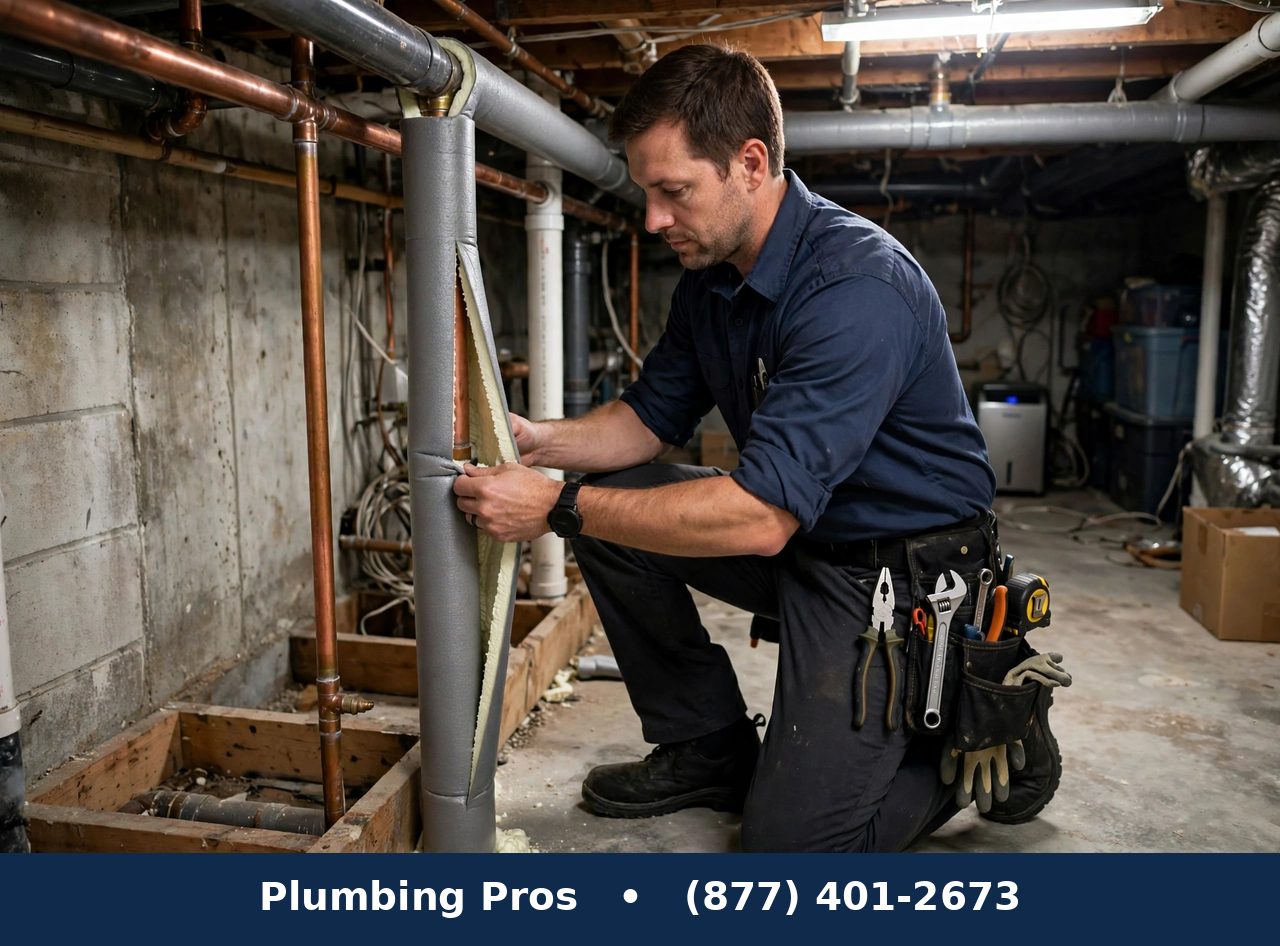
Straight runs get closed-cell foam sleeves. The sleeve slips over the pipe, the seam seals shut, and the wall thickness sets how strongly the run resists heat loss. Foam cannot bend around elbows, tees, valves, or manifolds. There we use fiberglass wrap with a vapor jacket, cut to fit and taped tight so no metal sits bare against cold air.
The coldest stretches get extra attention. Lines beside rim joists, inside vented crawl spaces, or along exterior chases may get self-regulating heat cable under the insulation. A thermostat switches the cable on only when the surrounding air drops toward icy conditions. Finally we seal every joint, check that the coverage is continuous from end to end, and show you what was covered on each run.
What affects the cost
Cost follows scope, not a flat rate. The biggest factor is how many feet of exposed pipe you have and how easy those runs are to reach. An open basement ceiling goes faster than a low crawl space you can barely enter. Pipe diameter and the number of fittings matter too, because every elbow, tee, and valve gets wrapped and sealed by hand.
Material choice plays a role as well. Foam sleeves on straight runs are the simplest option; fiberglass with vapor jackets on complex fittings and heat cable on the coldest sections add material and time. Existing insulation that has to be removed first adds a step, and urgent work during a cold snap takes longer to schedule than a planned pre-winter visit.
No one can price the job without seeing the runs, and you should be wary of anyone who tries. A walkthrough of the exposed plumbing is what turns these factors into an exact quote for your home.
How we serve your area
Plumbing Pros handles pipe insulation for single-family homes, rental properties, and small businesses with exposed utility lines. Garages, workshops, outdoor kitchens, and irrigation backflow lines all get the same careful treatment as indoor plumbing. If it carries water and sits in unconditioned space, it belongs on the walkthrough list.
Service starts with a clear conversation: where the exposed lines are, what the space looks like, and when the cold usually arrives. Then we schedule the visit, cover every run in one trip, and leave you with a simple map of what was insulated where. Reach out to Plumbing Pros before the first hard freeze and your plumbing will be ready when the temperature drops.
Features
- Closed-cell foam sleeves sized for straight copper and PEX runs
- Fiberglass wrap with vapor jackets for elbows, tees, and valves
- Self-regulating heat cable for the coldest exposed sections
- Sealed seams and joints so no bare metal touches cold air
- Full walkthrough of every exposed run before work starts
- Pipe-through-wall seals where lines cross exterior walls
Benefits
- Hot water reaches fixtures faster and stays hot longer
- Lower standby heat loss from hot-water lines
- Less condensation dripping from cold lines in summer
- Quieter plumbing with fewer ticking and expansion sounds
- Pipes far less likely to freeze, crack, or split
- A clear record of what was insulated on each run
Frequently asked questions
Will pipe insulation stop my pipes from freezing?
Insulation slows heat loss, which often keeps lines above freezing during ordinary cold snaps. In severe cold it may need help from heat cable, and no covering protects a line if the house itself goes unheated.
How much does pipe insulation cost?
It depends on the feet of exposed pipe, how easy the runs are to reach, pipe size, the number of fittings, and whether heat cable is needed. Only a look at your actual runs can turn those factors into a firm number.
Can pipe insulation help in summer too?
Yes. Cold-water lines sweat in humid months, and insulation with a vapor jacket stops condensation drips that stain ceilings and soak stored belongings.
Should I insulate the pipes on my water heater?
Covering the first several feet of hot and cold lines at the tank helps the heater hold its temperature with less standby loss. Keep the covering clear of the burner, draft hood, and any labels on the tank.
Is pipe insulation a DIY job?
Foam sleeves are simple on straight, easy-to-reach runs. Fittings, valves, and heat cable take more care, and skipped seams leave weak points — which is why a full walkthrough by a plumber usually finds spots homeowners miss.
What is the difference between foam and fiberglass pipe insulation?
Foam sleeves suit straight runs and install fast with sealed seams. Fiberglass wrap bends around elbows, tees, and valves where rigid foam cannot go. Most homes use both, each where it fits best.