Toilet Repair Near Me
Starting price: Call for pricing
A toilet that runs nonstop, rocks on its base, or needs two flushes to do the job is telling you something is wrong inside. Plumbing Pros finds the actual cause — worn flapper, faulty fill valve, failing seal, or deep clog — and repairs it with quality parts, usually in a single visit. When the toilet itself is past saving, we say so plainly instead of selling you parts it does not need.
What toilet repair covers
Toilet repair covers the mechanical parts that make a toilet flush, refill, and seal: the flapper, fill valve, flush lever, supply line, tank bolts, and wax ring. It also covers clogs lodged inside the bowl or trap, a toilet that rocks on the floor, and water leaking from the tank or the base.
Most failures are small parts wearing out. Rubber flappers warp and let water slip from the tank into the bowl. Fill valves lose their ability to shut off. Tank bolts rust and weep. These are quick repair jobs once the cause is known.
Repair has limits, and an honest plumber names them. A cracked tank or bowl cannot be fixed safely — porcelain under pressure can fail without warning. Toilets with discontinued internal parts reach a point where tracking down hardware is no longer sensible. When that point arrives, replacement is the better answer.
What toilet repair does not cover is anything past the flange. If the same toilet clogs every few weeks regardless of what goes down it, the blockage may sit deeper in the drain line. That is drain or sewer work, and it calls for different tools and a different visit.
Signs your toilet needs a plumber
One that needs a plumber usually announces it: constant running, a tank that refills by itself, a rocking base, a leak at the floor, repeated clogs, or a weak flush. An occasional single clog is normal in any home. A pattern — especially water appearing where it should not — is not, and waiting usually makes the repair bigger.
- Water trickling into the bowl long after the flush ends
- The tank refilling by itself, at any hour
- A flush that swirls weakly or leaves waste behind
- Rocking or shifting when you sit down
- Dampness or puddling around the base
- Clogs that keep returning no matter what you do
- A handle that sticks, jiggles loose, or does nothing at all
Two symptoms deserve fast attention: water at the base and a rocking toilet. Both point to a failing seal between the toilet and the floor flange, and both let water reach the subfloor with every flush. Subfloors soften quietly. By the time the damage is visible, the repair often extends beyond plumbing.
How a toilet repair visit works
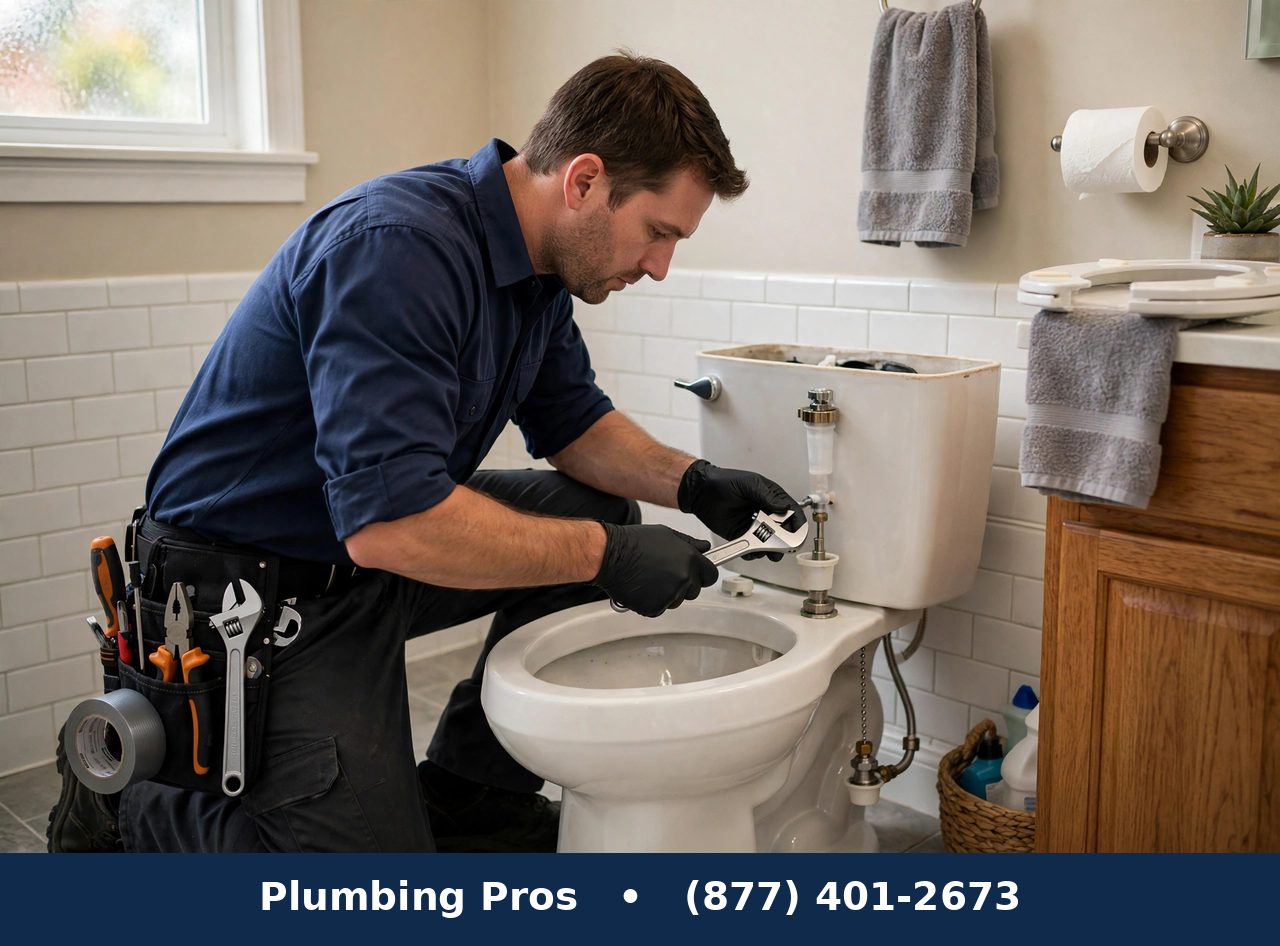
A toilet repair visit starts with your description of the symptoms, followed by a hands-on inspection of the tank internals, the base, and the supply line. The plumber identifies the cause and explains the fix and the parts involved in plain words. Most repairs finish on the spot, then get tested with several full flushes.
- You describe the symptoms: when it started, what it sounds like, what you have tried
- The plumber checks the tank: flapper, fill valve, water level, and overflow tube
- The base and supply line are inspected for leaks, rocking, and corrosion
- You hear the diagnosis in plain words — the cause, the fix, and the parts
- The repair is made and tested with several full flushes
Common parts — flappers, fill valves, supply lines — are standard enough that most visits finish in one trip. Odd or very old fixtures can need a part ordered in, in which case the plumber will say so before starting. Either way, you know the plan before any work begins.
What affects the cost of a toilet repair
The cost of a toilet repair comes down to what failed, how hard it is to reach, and what the fixture needs in parts. A flapper swap and a flange repair are different jobs with different labor and material demands. These are the factors that move the price:
- The failed part: small tank internals take less work than a seal at the floor
- The toilet's age and model: uncommon fixtures can need harder-to-find parts
- Access: tight bathrooms and corroded bolts slow the work down
- Damage already done: a long-leaking seal can mean subfloor work alongside the plumbing
- Repair versus replace: sometimes a new toilet is the cheaper long-term answer
No one can price the job honestly without seeing the fixture, so treat any number given over the phone as a guess. The reliable path is a look at the actual toilet. Describe the symptoms when you request service, and ask what the visit includes before the work starts.
How Plumbing Pros serves your area
Plumbing Pros serves homes, apartments, rental properties, and small businesses across the country, handling toilet problems as everyday plumbing work. The service area is nationwide, so the same process applies whether the toilet sits in a family bathroom or a commercial restroom.
Older homes bring their own patterns: aging tank internals, corroded supply lines, and fixtures that predate modern water-saving designs. Rentals and managed properties get the same straightforward treatment, with diagnoses clear enough to pass along to a landlord or tenant. For small businesses, a restroom out of order is a customer problem, not just a plumbing one, and it gets treated that way.
Every job ends with the same simple test: several full flushes, no running, no rocking, and no water where it should not be. When the toilet passes, the work area is left as it was found and the visit is done.
Features
- Running toilet diagnosis and repair
- Flapper and fill valve replacement
- Rocking toilet reset and resealing
- Stubborn clog removal
- Tank and base leak repairs
- Toilet replacement when repair will not hold
Benefits
- Repairs finished in a single visit in most cases
- The real cause fixed, not just the symptom
- Water wasted by a running tank is stopped
- Slow leaks caught before they damage floors
- Honest advice when replacement costs less than repair
- Work area left clean when the job is done
Frequently asked questions
Why does my toilet keep running after I flush?
The usual cause is a worn flapper letting tank water slip into the bowl, which drops the tank level and keeps the fill valve open. A fill valve that cannot shut off, or a water level set above the overflow tube, does the same thing. All three are routine repairs, and the wasted water stops as soon as the faulty part is replaced.
How much does it cost to repair a toilet?
It depends on the failed part, the toilet's age and model, how easy it is to access, and whether any water damage needs attention too. A simple internal-part swap is a smaller job than resealing a toilet to the floor. Describe the symptoms when you request service — an exact figure needs eyes on the actual fixture.
Can a cracked toilet tank or bowl be repaired?
No — cracked porcelain cannot be repaired safely and can fail without warning. Replacement is the only sound option. If the internal parts are also obsolete, a full fixture replacement often makes more sense than chasing hardware.
Why does my toilet rock when I sit on it?
Rocking usually means the flange bolts have loosened or the wax seal underneath has compressed or failed. It is not just annoying — every rock lets a little water escape toward the subfloor. Resetting and resealing the toilet fixes it, and should be done before the floor takes damage.
Why does the same toilet keep clogging?
Repeated clogs can mean a partial blockage lodged in the trap, low water in the tank giving weak flushes, or a problem deeper in the drain line. If plunging stops working and the pattern keeps coming back, the blockage is past what a plunger can reach.
My toilet flushes by itself sometimes. What is that?
That is called a phantom flush, and it means water is leaking from the tank into the bowl — almost always a worn flapper. The tank level drops, the fill valve opens to refill it, and the cycle repeats. Replacing the flapper ends it.